

Why the War?
By Joshua Lino

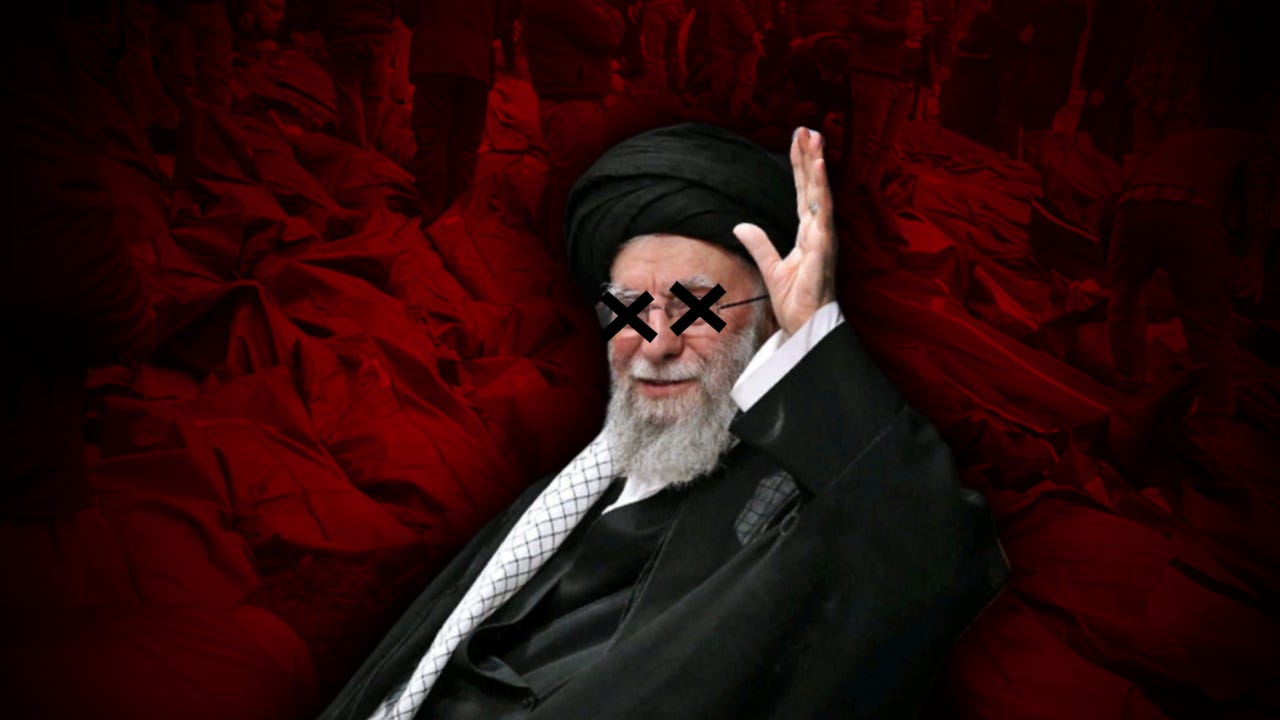
On February 28th of 2026, the United States of America, alongside the State of Israel, launched a series of joint airstrikes on the Islamic Republic of Iran, which has since rapidly erupted into a regional conflict involving almost every nation in the Middle East. Though the Iran War has been met with unanimous applause in Israel, with 97% of right-wing Jewish Israelis and 76% of left-wing Jewish Israelis supporting the operation, the conflict has been met with much more controversy in the United States of America. While 59% of American military veterans approve of the strikes, only 50% of the general public supports the strikes according to both Fox & Napolitan News, and the issue is seemingly entirely split based upon party lines.
And so, for many Americans, the justification for the war seems unanswered, or if it has been, they find the answer insufficient. So then, why the war? The answer is simple: That the 2026 Iran War was a necessary act of self-defense, and that it was an act a long time in the making.
HISTORICAL CONTEXT
Though some would like to celebrate a ridiculous and mythologized version of pre-Islamic Persian history, I have no such inclination. In fact, the hostility of Iran (or Persia, if you please) toward the Western world long predates the Islamic Republic by thousands of years.
Long before the Safavid or Qajar dynasties, the first great collision between the civilizations of the West and the Persian Empire occurred on the plains and seas of ancient Greece. In 492 BC, the Achaemenid king Darius the Great launched the first Persian invasion of Greece, as he sought to punish Athens and Eretria for their support of the Ionian Revolt, and to extend his empire’s dominion into the fractious world of the Greek city-states. After a campaign that subdued Thrace and Macedon, a second expedition landed at Marathon in 490 BC, only to be defeated by a smaller Athenian force in a victory that the Greeks understood as the triumph of free men over imperial slaves. A decade later, Darius’s son, Xerxes, assembled one of the largest armies of the ancient world (perhaps 300,000 men and over 1,200 warships), to crush Greece once and for all.
Against this tide, a coalition of Greek city-states, fractious and outnumbered, mounted their defense at Thermopylae, Salamis, and finally at Plataea in 479 BC. It is the Battle of Plataea that holds a singular distinction in Greek history: it was the first time the disparate Greek city-states, often locked in conflict with one another, fielded a unified army under a single command to fight as a single nation. Under the Spartan regent Pausanias, this coalition delivered a decisive blow that destroyed the Persian invasion force, proving that their collective identity could overcome their factionalism. As the Greek playwright Aeschylus, himself a veteran of Salamis, understood, the Persian Wars were a turning-point in the self-conception of the Greek people. From here on out, the Greeks became a people defined by freedom, by consensual government, and by the rule of law, as opposed to those barbarians who would prefer to live contentedly under despotism and tyranny, those who preferred servility to self-determination. This was the crystallization of a civilizational identity. “Histories” by the historian, Herodotus, was fundamentally framed around the struggle between Hellenic liberty and Persian autocracy. Here, in Greece, the foundational cultural features of the West were born: Democracy, philosophy, tragedy, and history.
John Stuart Mill, an infamous utilitarian and classical liberal, would notably declare that “the Battle of Marathon, even as an event in British history, is more important than the Battle of Hastings”. For in that clash, the clash between Persia and Greece, the West first defined itself against the East, and this definition would echo on through the centuries: In Rome’s struggle with Parthia, through the Crusades, and down to our own era. The Iran that chants “Death to America” is the same Iran that attempted to extinguish the Western world over two millennia ago, it’s an Iran that stands in the tradition that its predecessors inaugurated at Marathon and Salamis, and it’s a tradition that the West, from Athens to present, has always ultimately resisted and overcome.
The Safavid Dynasty, which began its rule in 1501, relentlessly persecuted Christians & Jews, expelling European merchants long before the first American diplomat set foot in Persia. The Qajar Dynasty, which began its rule in 1789, unhesitatingly violated treaties with the British Empire whenever it suited their expansionist ambitions, such as the 1853 Treaty of Paris guaranteeing Afghan independence, which Persia violated by invading Herat in 1856. Persia’s constant perception of the West as an adversary to be exploited when weak and expelled when strong has been a long-time pattern, regardless of how one would like to chalk it up.
The Pahlavi Dynasty, which began its rule in 1925, only ever cooperated with the West out of sheer opportunism, and due to a legacy of oil concessions. But domestically, the cultural transformation of Iran under the Pahlavis, especially under the final Shah, was entirely entrenched in anti-modern spiritualism and nativism. Mohammad Reza Shah Pahlavi explicitly stated that he desired a society “free from the blemishes of your [Western] society.” His White Revolution was always fundamentally an attempt to emulate a nativist “return to self.”
Iran’s Prime Minister Mohammad Mossadegh, who rose to power in 1951, was a dictator who, whether inadvertently or not, indeed enabled the rise of the communist Tudeh Party. Mossadegh only rose to power because he was appointed by the King, the Shah, who was initially his political ally. Mossadegh overrode parliament, eventually dissolved it in 1953, gave the premiership legislative authority, and marginalized Iran’s political institutions for his own personal gain. Before dissolving parliament in the 1952 elections, Mossadegh abruptly shut down the elections once 79 of 136 deputies were chosen, the minimum needed for a quorum, as he personally feared that opposition would dominate the rural seats, and he hoped to sideline the voice of the countryside. His own supporters won only 30 of those 79 seats. Once he fully nationalized Iran’s oil, Mossadegh’s government mismanaged it so severely that oil outputs by 1953 were 4% of what they had been in 1950. He caused rampant inflation, filled the government with loyalists and personal friends, and pushed through decrees unilaterally. Unemployment skyrocketed. He arrested and fined dissenters and proved completely incapable of managing an “oil-less” economy or allowing political opposition at all. He saw dissent as treason, sidelined independent judges, and curtailed the press whenever it dared criticize him.
In August of 1953, Mossadegh was overthrown by Britain and the United States. The United States rightfully overthrew Mossadegh as, since the nationalizations weakened the Iranian state, the communists, who had explicitly planned to overthrow the government, were now infinitely more likely to do so. If they had succeeded, Iran would simply have become another Soviet orbiter. Did the United States overthrow Mossadegh simply due to the fact that he had nationalized Iranian oil? No. Mexico nationalized its oil in 1938, Bolivia nationalized its oil both in 1937 and 1952, and Venezuela nationalized its oil in 1976. The United States was always fine with accepting nationalizations when the nation negotiated compensations for nationalizations, communist influence appeared unserious, or when the nationalizing government remained aligned with US strategic interests. The problem in Iran was that the Tudeh Party was gaining substantial influence, and Mossadegh rejected any compromise with the West all while his country remained seated on a very strategically vital location bordering the Soviet Union.
By the 1960s and 1970s, the Shah started actively pursuing working relationships with the Soviet Union and the Eastern Bloc. By 1973, he had fully nationalized Iran’s oil, transferring all operational roles to the National Iranian Oil Company, and by 1979, he had lost the support of all sectors of Iranian society. Liberal democrats, the religious community, and the private sector all rose up against him, resulting in the Iranian Revolution of 1979.
THE SITUATION AS IT STANDS
But let us restrict ourselves to the modern era, since it is the current regime that the United States was compelled to confront in 2026. And let us confront this problem frankly. The Islamic Republic of Iran has been in flagrant violation of its international obligations for its entire existence. In the revolution’s rhetoric, the United States became the “Great Satan.” In late 1979, Ruhollah Khomeini declared: “In this revolution the Great Satan is America that gathers [its] devils together.” The chant “Death to America” found its popularization in the earliest days of the 1979 uprising, alongside other slogans such as “Death to Israel” and “Death to the Shah.”
One should not forget the crisis that erupted from Iran’s hostage-taking of American diplomats that occurred in 1979. Once the Shah fell, Khomeini immediately marginalized his former partners in revolution. By mid-1980, Khomeini began executing hundreds of leaders from the National Front, the leftist People’s Mojahedin (MEK), and even secular-Islamists under the Muslim People’s Republican Party. His regime shut down dozens of non-Islamist newspapers in August of 1979, raided secular political parties, and purged schools and universities of “Westernized” faculty. By 1980, over 500 were executed. By mid-1981, executions topped 1,000.
From 1981 to 1982, the regime executed 3,000 leftists, socialists, liberal Muslims, and Bahai ethnics as “enemies of God.” These crimes against humanity were described by the clerics as “purifying” society. Every Friday prayer and every Quds Day rally saw crowds shouting, “Marg bar Âmrikâ!” State-run media and school textbooks picked up the motif, and posters read “Down with USA” and “Down with Britain.” Khomeini then scorned the Universal Declaration of Human Rights, stating “The imperialists proclaim that man is free only in order to deceive the masses… the Declaration of Human Rights exists only to deceive the nations; it is the opium of the masses.”
Iranian proxies and operatives carried out mass-casualty terrorist attacks on Americans unrelentingly, whether it be in the 1983 Beirut Marine barracks bombing, the 1996 Khobar Towers bombing, or the 2000 USS Cole attack. Iranian operatives funded and directed Hezbollah’s 1983 barracks bombing, the 1992 Israeli embassy attack in Buenos Aires, the 1994 AMIA Jewish center bombing, and the ongoing arming of Hamas and Palestinian Islamic Jihad (PIJ). They have provided lethal aid to Houthi rebels attacking international shipping, established Shia militias that have attacked both American personnel and Sunni civilians in Iraq and Syria, and through the IRGC and Quds Force trained, funded, and directed terrorist groups across the Middle East. A 2013 UN Panel of Experts found that the Quds Force was directly responsible for the Westgate Mall attack in Kenya, while Iraq’s government informed the UN Security Council that Iran-backed militias, notably Kata’ib Hezbollah, repeatedly launched violent assaults against its civilians.
Shahram Poursafi, an IRGC-Quds Force operative, has been charged by the US DoJ in attempting to assassinate former National Security Advisor John Bolton. As was later uncovered, Iranian hitmen nearly assassinated former Secretary of State Mike Pompeo in Paris in 2022, and the National Security Council has confirmed that it has, for the last few years, been tracking multiple Iranian plans to assassinate President Donald Trump. In 2011, Manssor Arbabsiar and IRGC-Quds Force member Gholam Shakuri planned to bomb a Washington DC, restaurant frequented by Saudi Ambassador Adel al-Jubeir.
Despite all of this, for decades, the international community has responded with unenforced resolutions that Iran continuously ignored, and negotiations that Iran only ever exploited to advance its nuclear program whilst giving nothing of substance in return.
IRAN’S NUCLEAR FILE
Initial Developments
The most existential threat which Iran poses to the world, undeniably pertains to its nuclear program. Iran, as a signatory to the Nuclear Non-Proliferation Treaty (NPT), is obligated to submit to International Atomic Energy Agency (IAEA) verification. Instead, it has resisted such verification for the last quarter-century. As early as the late 1980s, Pakistan’s AQ Khan network sold Iran P-1 centrifuge components, and by 1989, as reported by the Carnegie Endowment for International Peace, Iran was suspected of receiving its first centrifuge assemblies (about 2,000 components of German-designed machines from Pakistan). Over the 1990s, Iran’s nuclear program grew, with the clandestine fuel-conversion plants and clandestine enrichment at Natanz and Fordow being discovered by the West only during the 2000s.
Early IAEA “Cooperation”
As a confidence-building measure and in response to the global War on Terror, Iran submitted to inspections in 2003 and signed the Additional Protocol allowing surprise IAEA inspections. Still, the IAEA flagged “possible military dimensions” of the Iranian nuclear program, confirming that prior to 2003, Iran undertook “a range of activities relevant to the development of a nuclear explosive device.” In 2006, the UN Security Council, in Resolution 1,696, demanded that Iran suspend all uranium enrichment activities. Iran never complied. The UN then imposed sanctions through Resolutions 1,737, 1,747, 1,803, and 1,929 from 2006 to 2010 to curb Iran’s program. The 2007 US National Intelligence Estimate estimated that Iran was “technically capable of producing enough highly enriched uranium for a weapon between 2010 and 2015.”
And yet, even as Iran claimed to cooperate, the forensic trail of its intentions grew hotter. The IAEA’s November 2011 report laid bare the architecture of what it called the “possible military dimensions” of the Iranian nuclear program. According to credible intelligence from the era, Iran had maintained a structured military program through 2003, including specific activities related to the development of a nuclear payload for a missile. The IAEA determined that certain weapons-applicable work, involving computer modeling of nuclear explosions and the development of high-explosive detonation systems, continued in Iran until as late as 2009.
The JCPOA
The solution to the threat that Iran posed was the JCPOA, or Joint Comprehensive Plan of Action, adopted in 2015, and enacted in 2016. Under this deal, Iran agreed to limit enrichment to 3.67% Uranium-235, cut its centrifuge count, convert its 20%-enriched stock to fuel or oxide, and accept strict IAEA monitoring including continuous online camera feeds. The UN Security Council’s Resolution 2231 endorsed the terms of the JCPOA and lifted UN sanctions on Iran for its compliance. Yet even during the supposed “compliance” period from 2016 to 2018, Iranian officials publicly rebuffed IAEA requests to inspect military sites. President Rouhani declared military bases “off limits” to UN inspectors and mocked America’s demands for access, referring to them as a pipedream. In his own words “Iran’s military sites are off limits. All information about these sites are classified. Iran will never allow such visits. Don’t pay attention to such remarks that are only a dream.”
Project Amad & the SPND
In April of 2018, Israeli intelligence agents exfiltrated roughly 110,000 pages of Iran’s “Project Amad” files, which contained advanced bomb-related research on uranium-metal fuel, neutron generators, and high-explosive tests. The following month, in May of 2018, the United States withdrew from the JCPOA and reimposed sanctions on Iran. Secretary of State Mike Pompeo declared, “I can confirm with you, for you, that these documents are real, they are authentic. The Iranians have consistently taken the position that they’ve never had a program like this. This will belie any notion that there wasn’t a program.” Former IAEA inspector Olli Heinonen confirmed to the Guardian that his department had in fact seen some of the documentation of Project Amad as early as 2005 and concluded that “evidence of Project Amad was credible”. Nuclear engineer and former IAEA inspector Robert Kelley reviewed the documents and stated: “It’s quite good. The papers show these guys were working on nuclear bombs.”
Yet despite this mountain of evidence, Iran’s response was to deny the very existence of this program entirely. Iranian officials dismissed the archive as fabricated, despite IAEA corroboration, and instead proceeded with their now clear lie: That they never pursued nuclear weapons at all. The trove of approximately 110,000 pages of Iran’s “Project Amad” files, which the Israeli agents exfiltrated, laid bare this program that had been deliberately concealed from the international community. After this revelation, Iran’s strategy became clear: it was not to abandon its nuclear ambitions, but to preserve the capacity for them. The Amad archive revealed that when the decision was taken in 2003 to halt Iran’s work on large identifiable facilities, the leaders of Iran’s nuclear program continued their research to fill technical gaps that they believed still needed work. In other words, the “stop work” order did not in fact stop all of Iran’s work, it merely retarded it.
The successor of Project Amad, known as the SPND (Organization of Defense Innovation and Research), commenced operations in 2010 under the direct mandate of Supreme Leader Khamenei, who deemed it “a strategic and fundamental necessity”. Mohsen Fakhrizadeh, who had operated as the architect of the Amad Plan, remained in charge of SPND until his assassination in late 2020, bringing with him the core personnel who had worked on nuclear weaponization in the early 2000s. By 2024, Iran’s parliament passed a law granting the SPND total financial and administrative independence, exempting it from the National Audit Office and parliamentary oversight, while providing it the largest exclusive budget of any military organization in Iran, making its operations “financially independent, autonomous, and confidential, even from other parts of the government”.
The United States assessed, based on this data and Iran’s subsequent behavior, that Tehran’s retention of these files and documents, its determined efforts to keep this information from the IAEA, and its reassignment of the scientists and officials from the Amad Plan into the structure of the SPND, suggested a singular, troubling intent. These actions were undertaken to preserve the technical expertise and knowledge crucial for nuclear weapons capability, thereby laying the groundwork to pursue nuclear weapons, should the regime ever make that final, fateful decision.
All Downhill From Here
From 2019–2021, Iran ceased implementing the Additional Protocol and halted snap inspections. By May of 2019, Iran had about 408.6 kg of uranium enriched to 60%, up from roughly 275 kg in February 2019. Even 42 kilograms of 60%-enriched uranium is theoretically enough for one nuclear bomb if further enriched to 90%. Iran’s total enriched uranium stockpile was about 9,247 kg by mid-2019.
Then, in November 2019, the IAEA Director General called for a rare emergency special session of the Board of Governors. The session addressed two urgent and pressing issues pertaining to Iran’s malevolent designs:
First, the IAEA’s detection of particles of chemically processed, or anthropogenic, uranium, specifically, isotopically altered particles of low enriched uranium with a detectable presence of U-236, at a location in Iran not declared to the Agency.
Second, Iran’s late October detention of an IAEA inspector.
The IAEA soon confirmed to member states that this aforementioned undeclared site was the Turquzabad warehouse, the very facility in Tehran that Israeli Prime Minister Netanyahu had publicly identified in September 2018, as containing equipment and materials from Iran’s past nuclear weapons program, material which Iran had allegedly hastily removed. In January of 2020, Iran was formally asked under Article 4.b(i) and Article 5.c of the Additional Protocol to provide access to two specified locations. Iran’s response was a blunt refusal, verbally informing the IAEA that it would not recognize any allegations on past activities, and did not consider itself obliged to respond. Such a prolonged refusal, lasting over four months, was unprecedented under the Additional Protocol (an instrument specifically designed to detect undeclared nuclear materials).
The IAEA’s investigations had, by March of 2020, identified a number of questions related to possible undeclared nuclear material and nuclear-related activities at three locations that Iran had never declared. One location was tied to the possible presence in Iran between 2002 and 2003 of natural uranium in the form of a metal disc, with indications it had undergone drilling and hydriding, activities of significant proliferation concern given uranium metal’s direct relevance to nuclear weapons research. The IAEA noted that this site had been subjected to extensive sanitization and levelling in 2003 and 2004, destroying any possibility of verification. A second location was suspected of having been used for the processing and conversion of uranium ore, including fluorination, in 2003. The regime dissolved most of this site’s buildings in 2004. A third location, where outdoor conventional explosive testing was thought to have taken place in 2003, showed evidence of sanitization as recently as July of 2019, as Iran has seemingly attempted to repurpose or erase evidence of the site’s past function.
It took a resolution by the IAEA Board of Governors in June of 2020, tabled by France, Germany, and the United Kingdom, to finally pressure Iran into providing access to the two locations requested by the IAEA, which it grudgingly did in August and September of 2020. Yet, access didn’t equate to answers. Even after the visits, the IAEA’s November 2020 report made clear that Iran’s explanations for the uranium particles remained technically uncredible and unsatisfactory. The matter of the uranium disc, the potential conversion activities, and the explosives testing all remained open, gaping questions about Iran’s commitment to the completeness and correctness of its safeguards declarations.
In November 2020, the IAEA reported that Iran’s total low enriched uranium stockpile had ballooned to approximately 3,613.8 kg (in UF6 mass), exceeding the JCPOA’s cap by 1,200%. At the Natanz Pilot Fuel Enrichment Plant, Iran was testing no fewer than fifteen different centrifuge models (the IR-1, IR-2m, IR-3, IR-4, IR-5, IR-6, IR-6m, IR-6s, IR-6sm, IR-7, IR-8, IR-8s, IR-8B, IR-s, and the IR-9), installing advanced cascades, and accumulating enriched uranium from them. Five smaller cascades of IR-4s, eight IR-5s, six IR-6s, and another cascade of 20 IR-6s were operational. Larger cascades of 152 IR-4s and 110 IR-6s were also actively enriching. Iran had begun transferring these advanced centrifuges from the above-ground pilot plant to the underground Fuel Enrichment Plant at Natanz, and moving 174 IR-2m centrifuges underground and feeding them with UF6 by November 2020.
Following the November 2020 assassination of the SPND’s leader, Mohsen Fakhrizadeh, in December of 2020, Iran’s parliament passed a law mandating the government to expand its nuclear activities. This new law required the production of a minimum of 120 kilograms of 20% enriched uranium annually and the installation of at least 1,000 IR-2M centrifuges within three months. It further mandated a reduction of cooperation with the IAEA to the bare minimum required by its Comprehensive Safeguards Agreement, thereby ceasing all implementation of the Additional Protocol.
In June of 2022, Iran removed all IAEA monitoring cameras and surveillance equipment from all of its nuclear sites. Then, in early 2023, the IAEA verified that Iran was using two 166-machine IR-6 centrifuge cascades at Fordow to enrich uranium up to 60%, quite close to weapons-grade. The Agency was “concerned” that this “substantial change” had been implemented without prior notification by Iran to the IAEA. Iran had only informed the IAEA after the Agency discovered the change. The IAEA Report from November of 2023 confirmed that Iran refused IAEA checks on its heavy-water reactor program, denied daily access to Natanz and Fordow, refused to permit monitoring of stored centrifuges, blocked verification of low-enriched uranium feed, and prevented tracking of uranium compound transfers. Iran also blocked IAEA centrifuge component inspections.
Iran proceeded to then expel a number of IAEA inspectors. The IAEA later reported Iran’s cooperation to be “less than satisfactory” in resolving questions about uranium traces at undeclared sites. Then, in July of 2025, Iran’s parliament banned cooperation with the IAEA, leading the IAEA Board to declare Iran in non-compliance. A confidential IAEA report in May of 2025 and covering up to March of 2025 stated: “The Agency concludes that Iran did not declare nuclear material and nuclear-related activities at three undeclared locations in Iran, specifically, Lavisan-Shian, Varamin, and Turquzabad.”
The Nail in the Coffin
According to the IAEA’s May 31st, 2025 report, the afformentioned uranium disk was a piece of uranium metal used at the Lavisan-Shian site in Tehran. Its purpose was not related to power generation, but to weapons development. It was “used in the production of explosively-driven neutron sources”, a process exclusively designed to initiate the explosion in a nuclear weapon. The IAEA confirmed that this occurred at least twice in 2003 as part of “small-scale” tests and concluded that Lavisan-Shian was one of several locations that were “part of an undeclared structured nuclear program carried out by Iran until the early 2000s”. The report also revealed that nuclear material or heavily contaminated equipment from this program was stored at Turquzabad as recently as 2018, with its current whereabouts unknown.
By 2026, Iran openly possessed roughly 440 kg of uranium enriched to 60% purity, “enough, if enriched further, for nine nuclear weapons,” according to the IAEA.
MISSILE PROGRAM & REGIONAL AGGRESSION
Beyond its nuclear program, Iran has developed ballistic missiles and armed drones designed to deliver large payloads over long distances, supplying them to allied non-state forces in Syria, Iraq, Yemen, and Lebanon in violation of UN embargoes. The UN Security Council repeatedly, including in 2015, called upon Iran “not to undertake any activity related to ballistic missiles designed to be capable of delivering nuclear weapons.” Iran ignored these calls and proceeded to develop space-launch vehicles and medium-range missiles like the “Khorramshahr” series capable of delivering large warheads.
The regime's appetite for American blood is matched only by its appetite for American technology, technology it has stolen systematically, brazenly, and with the direct endorsement of the Supreme Leader himself. In April of 2025, the US Department of Justice unsealed charges against Hossein Akbari and Reza Amidi, two Iranian nationals, and their company, Rah Roshd, revealing a procurement network that funneled components from the United States directly into the drones that kill civilians on behalf of the Islamic Revolutionary Guard Corps (IRGC).
The scheme's operation is as simple as it is sinister: between January of 2020 and the date of the charges, Akbari and Amidi used spoofed email addresses, shell companies in the United Arab Emirates, and payments laundered through US correspondent banks to acquire American-made parts (including servo motors, pneumatic masts, and advanced electronics) and ship them to Iran. There, these components were integrated into drones manufactured by Iranian state-owned enterprises like Qods Aviation Industries and Shahed Aviation Industries, companies whose commercial managers, like Amidi himself, rotate seamlessly between "private" procurement firms and the state's military-industrial apparatus.
The destination of these drones is now a matter of forensic certainty. In September of 2022, the Ukrainian Air Force shot down an Iranian-made Mohajer-6 drone operated by the Russian military. Inside its wreckage, investigators found parts manufactured by a company in Brooklyn, New York. The same servo motor that Rah Roshd procured, the same pneumatic mast it smuggled, had been used to kill Ukrainians in the war of aggression launched by the Kremlin. Yet the regime's gratitude for this service is not hidden. The DoJ’s investigation uncovered a letter from the head of the UAV Command for the IRGC's Aerospace Force, addressed to Rah Roshd, thanking the company for its contributions to Iran's defense capabilities.
The letter quoted the Supreme Leader of Iran himself, invoking his words on the importance of domestic production to “disappoint the enemies of the Islamic Republic.” This is the Islamic Republic's own voice, in its own words, celebrating the theft of American technology to arm a genocidal war in Europe. The regime that has lectured the world on “anti-imperialism” is the same regime that has relied on American factories to build its drones, Chinese suppliers to sell it components, Emirati shell companies to hide its payments, and Russian soldiers to fire its weapons. Iran is a parasite on the global economy, consuming the ingenuity of free societies to fuel the murder of free peoples.
GLOBAL TERROR
In February 2026, the European Union formally designated the Islamic Revolutionary Guard Corps (IRGC) as a terrorist organization, a designation that followed years of documentation showing the IRGC’s Quds Force training, funding, and directing terrorist groups across the Middle East. The EU’s designation was based upon the IRGC’s provision of ballistic missiles and drones to Hezbollah, Hamas, and the Houthis, as well as its direct involvement in assassination plots against dissidents in Europe. Rather than deny the allegations, the regime retaliated by designating the naval and air forces of all EU member states as “terrorist organizations.”
But let us be precise about what this "involvement" means, for the regime's campaign of extraterritorial murder is not a matter of allegations but of documented body counts spanning five decades. The blood-diminished thread begins as early as 1980, when Ali Akbar Tabatabaei, a leading critic of the Khomeini regime and then-president of the Iran Freedom Foundation, was shot dead in front of his home in Bethesda, Maryland. The assassin, disguised as a postal courier, was later identified as Dawud Salahuddin, born David Theodore Belfield, a security guard at an Iranian interest office in Washington, DC, who confessed to accepting the assignment and payment of $5,000 directly from the Government of Iran. The message was clear: That no exile was safe, not even in the suburbs of the American capital.
Throughout the 1980s and 1990s, the regime’s long arm reached across Europe and Asia to silence all of its opponents. In 1991, the fatwa issued by Ayatollah Khomeini against author Salman Rushdie remained in full force, and in 1992, the British Foreign Office expelled two Iranian embassy employees and a third Iranian on a student visa amid concrete allegations that they were plotting to assassinate the Indian-born British American novelist, Rushdie, on British soil. That same year, four Iranian Kurdish dissidents were assassinated while dining at the Mykonos restaurant in Berlin, a massacre that a German court would later determine was directed by the highest levels of the Iranian intelligence services. Also in 1992, the singer, actor, poet, and homosexual Iranian dissident Fereydoun Farrokhzad was found stabbed to death in his apartment in Germany, his murder generally attributed to Tehran’s agents. Then, over a five-month period in 1996, Iranian agents allegedly assassinated five Iranian dissident exiles in Turkey, Pakistan, and Baghdad.
The 21st century brought about only an expansion of this international bloodbath. In 2012, an Iranian American pleaded guilty to conspiring with members of the Iranian military to bomb a popular Washington, DC, restaurant (the location chosen specifically to assassinate the Saudi Ambassador to the United States). In 2017, Germany convicted a Pakistani national for working as an Iranian agent, tasked with spying on targets that included a former German lawmaker and a French-Israeli economics professor. The following year, German security forces launched a nationwide manhunt for ten alleged spies working for Iran’s Quds Force, operatives who had been tasked with collecting detailed information on targets related to the local Jewish community, including kindergartens. In 2018 alone, an Iranian diplomat was convicted in Belgium for attempting to carry out a bombing of a dissident rally in France, while a Danish high court found a Norwegian citizen of Iranian descent guilty of illegal espionage and complicity in a failed plot to kill an Iranian Arab dissident in Denmark.
In 2019, Iranian operatives allegedly lured Paris-based Iranian journalist Ruhollah Zam to Iraq, where he was abducted, returned to Iran, and hanged on charges of sedition. That same year, a Kurdistan regional court convicted an Iranian woman for attempting to lure Voice of America reporter Ali Javanmardi to a hotel room in Irbil as part of a foiled intelligence plot to kidnap and extradite him. Also in 2019, Turkish counterterrorism files exposed how Iranian authorities allegedly collaborated with drug gangs to kidnap Habib Chabi, an Iranian-Swedish activist for Iran’s Arab minority. Mr. Chabi was lured to Istanbul through a female agent posing as a potential lover, then kidnapped and smuggled across the border into Iran, where he was executed via hanging in May of 2023 following a sham trial. In 2020, Iranian agents kidnapped United States resident and Iranian-German journalist Jamshid Sharmahd while he was traveling to Dubai, announcing their seizure in a “complex operation” and parading him blindfolded on state television; he remained arbitrarily detained until he was executed via hanging on October 28th of 2024. That same year, the Government of Turkey released files showing how Iranian authorities had similarly orchestrated the 2019 assassination of Iranian dissident journalist Masoud Molavi Vardanjani, who was shot while walking with a “friend” in Istanbul, a friend who, according to a Turkish police report, was in fact an undercover Iranian agent and the leader of the killing squad.
Nowhere is the regime’s contempt for American sovereignty more nakedly displayed than in its relentless pursuit of its critics on United States soil. In 2019, FBI agents visited the rural Connecticut home of Iran-born American author and poet Roya Hakakian to warn her that she was the target of an assassination plot orchestrated by the Government of Iran. In 2020, a United States-Iranian citizen and an Iranian resident of California pleaded guilty to charges of acting as illegal agents of the Government of Iran by surveilling Jewish student facilities, including the Hillel Center and Rohr Chabad Center at the University of Chicago, and collecting identifying information about United States citizens critical of the regime.
The case of Masih Alinejad, a United States citizen, women’s rights activist, and journalist, showcases the regime’s obsessive cruelty most viscerally. In 2021, Iranian intelligence agents were indicted for plotting to kidnap Ms. Alinejad from her home in New York City, in direct retaliation for exercising her First Amendment rights. These Iranian agents allegedly spent at least half a million dollars on the operation, studying the feasibility of evacuating her by military-style speedboats to Venezuela before her ultimate rendition to Iran. Prior to this New York plot, Iranian authorities had already arrested three of Ms. Alinejad’s family members in 2019, and sentenced her brother to eight years in prison for refusing to denounce her, all in a transparent attempt to intimidate her into silence. According to Federal prosecutors, the same Iranian intelligence network that plotted to kidnap Ms. Alinejad is actively targeting other critics of the regime who reside in Canada, the United Kingdom, and the United Arab Emirates. Yet even the kidnapping plot against Masih Alinejad, chilling as it was, was merely a restrained attempt. When it failed, the Islamic Republic escalated its assault on Alinejad.
Then, in October of 2025, the US Department of Justice announced that two high-ranking leaders of the Russian mob, Rafat Amirov, a "Vor" or Thief-in-Law, and his cousin Polad Omarov, had been sentenced to 25 years in prison for a murder-for-hire plot targeting Alinejad on behalf of the Iranian government. After the IRGC's kidnapping efforts collapsed in 2021, the regime had turned to transnational organized crime, offering Amirov $500,000 to silence the journalist permanently. The IRGC provided Alinejad's home address in Brooklyn, details of her family, her patterns of her movement. Amirov passed this information to Omarov, who relayed it to Khalid Mehdiyev, a mob associate then residing in Yonkers, New York. From the IRGC's advance payment, $30,000 was delivered to Mehdiyev, who used it to purchase an AK-47 style assault rifle, two magazines, and 66 rounds of ammunition.
In late July of 2022, Mehdiyev conducted repeated surveillance outside of Alinejad's residence, sending photographs and videos to Omarov, who updated Amirov, who answered to the IRGC. On July 27th, Omarov messaged Amirov that the murder would be "over today," promising to make it a "birthday present." The following day, Mehdiyev sent a video from inside his car, the assault rifle visible, with the message: "we are ready." As he drove away from Alinejad's neighborhood that evening, police stopped him for a traffic violation. Inside the vehicle, they found the rifle, the magazines, the 66 rounds, and one round already in the chamber. The regime had come within minutes of murdering an American journalist on the streets of Brooklyn. When Mehdiyev was arrested, Omarov contacted his mother and threatened to kill her and her other son if she did not locate him, in part because the IRGC was demanding its money back.
The global scale of this terror network is staggering. In 2021, fifteen militants allegedly working on behalf of the Government of Iran were arrested in Ethiopia for plotting to attack citizens of Israel, the United States, and the United Arab Emirates. That same year, the British Broadcasting Corporation was compelled to appeal to the United Nations to protect its Persian service employees in London, who suffer regular harassment and threats of kidnapping by Iranian government agents. To the Islamic Republic, anyone who speaks against the regime, anywhere in the world, is a legitimate target for abduction, assassination, or intimidation.
HUMANITARIAN CATASTROPHE
After the disputed 2009 elections, Human Rights Watch documented “scores of reformist politicians, intellectuals, and journalists” arrested and killed during protests. Moderate clerics who opposed the theocratic constitution, like Grand Ayatollah Shariatmadari, were sidelined or arrested. Student groups, women’s rights activists, labor unions, and moderate religious organizations were all suppressed and outlawed. In 2019, over the course of less than two weeks, Iranian security forces cracked down on anti-government protests across Iran, killing approximately 1,500 people, including 400 women. Iran’s repression of dissent has repeated on an exponentially larger scale in the latest wave of demonstrations that began in late 2025. According to the Human Rights Activists News Agency (HRANA), at least 7,002 protesters have been killed in the crackdown, including 214 security personnel, with over 52,941 others detained.
The Supreme Leader himself publicly admitted that “several thousand” had died in the crackdowns. As of February 2026, at least 30 protesters were officially sentenced to death following nationwide demonstrations, with hundreds more facing execution on charges of “enmity against God”. These sentences were based on confessions extracted under torture and aired on state media in show trials where the defendants were denied access to lawyers and tried oftentimes before the infamous “Death Judge” Abolghasem Salavati, who built his reputation on mass executions. In one case, 18-year-old Saleh Mohammadi was sentenced to death by Salavati less than three weeks after his arrest, after retracting confessions he said were extracted under torture that left him with fractured hands.
INTERNATIONAL JUSTIFICATION
Under both US and international law, the decision to strike Iran was justified as an act of self-defense, the only logical reaction to a sustained campaign of aggression. Article 51 of the UN Charter affirms every nation’s “inherent right of individual or collective self-defense if an armed attack occurs.” It does not require that the attack be imminent in the narrow sense. It requires only that an armed attack has occurred. Iran’s armed attacks against the United States and its allies have been continuous for decades, be it through proxies, through direct plots, through the provision of bombs that have killed American soldiers, through cyber intrusions, or through assassination attempts on American soil. When a state has repeatedly attempted to murder American officials and civilians, when it has the capability and manifest intent to do so, when it has declared its hostility for over forty years and acted on it at every opportunity, war is already here. Self-defense is not a clock that resets when hostilities pause. It is a condition that persists as long as there is a threat that requires it.
America’s allies have supported the current strikes in precisely these terms.
Australian Prime Minister Anthony Albanese has declared, “For decades, the Iranian regime has been a destabilising force, through its ballistic missile and nuclear programs, support for armed proxies, and brutal acts of violence and intimidation… We support the United States acting to prevent Iran from obtaining a nuclear weapon and to prevent Iran from continuing to threaten international peace and security”. Canadian Prime Minister Mark Carney stated “Canada’s position remains clear: the Islamic Republic of Iran is the principal source of instability and terror throughout the Middle East, has one of the world’s worst human rights records, and must never be allowed to obtain or develop nuclear weapons … Canada supports the United States acting to prevent Iran from obtaining a nuclear weapon and to prevent its regime from further threatening international peace and security”. While not joining offensive strikes, British Prime Minister Keir Starmer authorized American use of British military bases for “defensive” strikes on Iranian missile sites and stated that the UK is discussing “a range of options” with allies to secure shipping in the region.
Albanian Prime Minister Edi Rama announced that the IRGC “is a terrorist organisation, and it must be treated as such,” and endorsed “every decisive effort to prevent, once and for all, the murderers in Tehran from acquiring nuclear or any other military capacity”. President Volodymyr Zelensky linked the U.S. action to global deterrence, asserting that “Whenever there is American resolve, global criminals weaken”. President Vjosa Osmani of Kosovo described the strikes as the arrival of Iran’s hour of freedom.
The War Powers Resolution permits the president to initiate hostilities without prior congressional approval when “a national emergency exists created by attack upon the United States, its territories or possessions, or its armed forces.”
That emergency has been ongoing for years.
It did not begin on February 28th, 2026.
It has been ongoing since the hostage-taking of 1979, the barracks bombings of 1983, the Khobar Towers of 1996, the USS Cole in 2000, the assassination plots of American officials in Washington and New York, and the murder-for-hire schemes that brought hitmen within minutes of killing an American journalist in Brooklyn.
CONCLUSION
The Iran War is the culmination of decades of Iranian malice. Every facet of the Islamic Republic’s behavior justified swift and decisive action. The United States had not merely the right, but the duty to eliminate the threat Iran posed before it grew even deadlier. As our allies in Europe and Israel have affirmed, this war was an act of self-defense, the work of a civilized nation finally acting to stop a regime that has defied peace for generations. For the millions of Iranians who yearn for freedom, for the victims of Iranian terrorism across four continents, and for the preservation of international order, America’s response was long-overdue.
In the words of former Vice President Cheney in 2004, “Just as surely as the Nazis during World War II and the Soviets during the cold war, the enemy we face today is bent on our destruction. As in other times, we are in a war we did not start, and have no choice but to win.”
When the history of the Islamic Republic is examined honestly, the only mystery left is why the United States didn’t neutralize this threat far sooner. The West has faced this adversary before, on the plains of Marathon and the pass at Thermopylae. Now, just as then, we have resisted, and we have overcome. The Iran War was, and remains, a war of necessity.
Wow this is Neo-Con bullshit. Would you attack Pakistan or the Saudis? Because they have arguably done everything you accuse Iran of and possibly worse but no cheerleading from you to bomb those countries that sponsor groups the US labels as Terrorists. No calls from you to urgently invade North Korea you coward Neo-Con.